
Vehicle disinfection tunnels
In biosecurity the weakest link is usually the front gate. We build fully automatic tunnels that cover both the vehicle entering the site and its driver, in the same movement.
- Control
- PLC + touchscreen
- Covers
- Vehicle and personnel
- Winter
- Automatic antifreeze protection
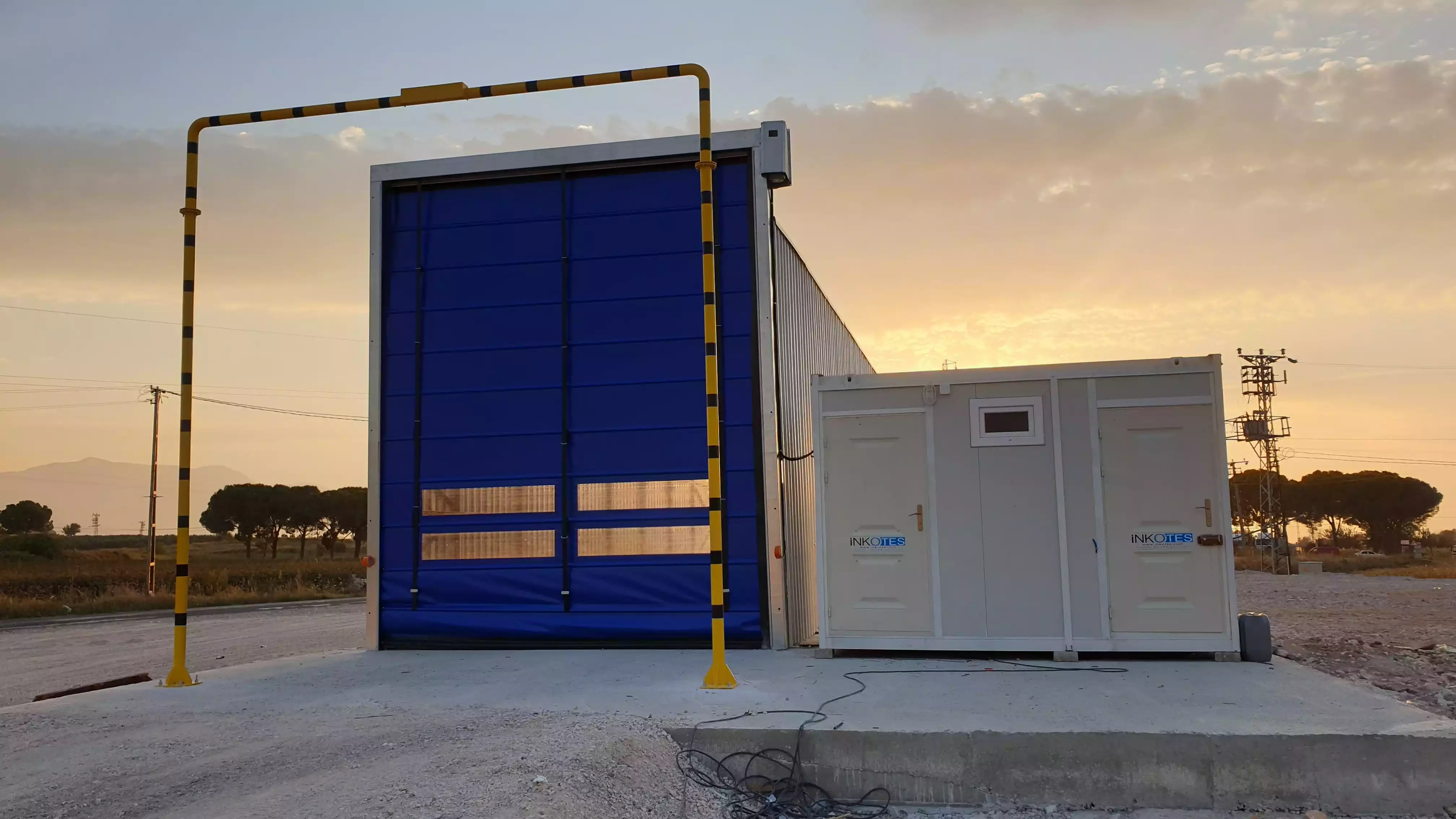
Where they are used
A disinfection tunnel is installed to stop disease agents being carried into a facility on vehicles and people. The heaviest use is at poultry farms, cattle and sheep operations, feed mills, hatcheries, food production plants and breeding units.
At these sites the cost of an outbreak is not comparable to the cost of a tunnel. For that reason the tunnel is usually installed not as a preference but as part of the operating procedure.
How the cycle works
The system is fully automatic, and it works not while the vehicle is passing through but while the vehicle is stopped inside the tunnel. The sequence runs as follows:
- The vehicle is detected. As it approaches, a magnetic sensor picks it up. The cycle can also be started with a push button.
- The exit door closes. The fast door at the tunnel exit closes automatically; the vehicle pulls up to it and stops.
- The driver gets out and is disinfected. They pass through the service door into the personnel disinfection unit.
- Vehicle disinfection begins. Once the driver's cycle is complete the system starts automatically, and atomised disinfectant fills the tunnel as a fog.
- The door stays shut. Wind therefore cannot disperse the fog, and the disinfectant reaches into the most sheltered parts of the vehicle.
- The cycle ends on time. When the fogging and dwell times set for the disinfectant in use have elapsed, the door opens, the driver gets back in and enters the site.
The most important consequence of this arrangement: the exit door does not open until the cycle is complete, so an untreated vehicle cannot get in. In a power cut or a fault, the system can also be run manually.
The personnel unit
Disinfecting the vehicle and skipping the driver leaves a gap in the biosecurity chain. The tunnel is therefore installed together with a personnel disinfection system.
The driver enters the unit through the service door, and hands, clothing and footwear are disinfected. The personnel unit and the vehicle tunnel share the same automation cabin; both are managed from one panel.
Structure of the tunnel
- Steel construction. Posts made from rectangular section, with roof profiles curved to suit the width. The side walls carry cross-bracing at the start, end and centre bays.
- Hot dip galvanising. The entire steel structure is hot dip galvanised against corrosion.
- Cladding. Side walls and roof are clad in galvanised, painted trapezoidal sheet. Connection and floor fixing plates are made from steel sheet.
- Nozzle line. Umbrella-angle stainless steel atomising nozzles distributed along the tunnel spread the fog evenly through the whole volume.
- Fittings. Rubber-lined stainless clamps, chrome-plated nozzle carriers and high pressure hose are used for the nozzle and pipework installation.
- Sensor-operated service door. Positioned on the cabin side for the driver to reach the personnel unit.
- Automation cabin. Sandwich panel walls and door, insulated roof and floor, ventilation window. The cabin is thermally insulated and automatically heated.
Automation and control
The system is PLC-controlled and all settings are made through a touchscreen. Managed from the panel:
- Disinfection cycle duration (two separate time settings can be configured)
- Monitoring of cabin and outside temperature, and setting the operating range
- Water, chemical and antifreeze level monitoring: if any runs out the system goes into alarm and will not run a cycle
- Automatic maintenance of tank level where mains water is connected
- Fault and service alerts, including oil change timing, on screen and audible
- A counter showing the number of vehicles disinfected
Level monitoring is not just a convenience but a protection: when water or chemical runs out, the system stops rather than letting the pump and motor run dry. In the same way, after a service alert the system protects itself and will not run until maintenance has been carried out.
A dosing pump keeps the disinfectant mixed at a fixed ratio. In hand-mixed tanks the ratio drifts: concentration changes as the level drops, the chemical settles out, and different shifts use different measures. The result is either an ineffective application or wasted chemical.
Winter protection
Biosecurity is needed all year, yet a water-based system carries a freezing risk. Our system resolves that automatically.
When the outside temperature falls below the set limit, the PLC pushes antifreeze through the entire external pipework and prevents freezing. If a vehicle arrives while the system is in that state, it draws the antifreeze back into its tank, runs the disinfection cycle, then returns to the protected state.
On the cabin side, a digital temperature controller switches on a radiant heater when the internal temperature drops below its limit. Freezing risk through winter is therefore not left to operator initiative.
Operator safety
- Low control voltage. The entire control system, including valves, indicator lamps and buttons, is built from low voltage components, removing the risk of electric shock.
- Traffic signal lamp. Red and green LED lamps at the entrance and exit direct the driver.
- High protection class start button. A button rated for outdoor conditions is used at the tunnel exit.
- Materials to standards. Long-life products compliant with TSE and CE norms are used for electrical protection components.
- Enforced sequence. The door does not open until disinfection is complete.
Installation and handover
We manufacture and install the tunnel. What needs to be prepared on the client's side is: the concrete foundation and bringing electricity and water to the location.
Provided the groundwork is completed on time, our delivery process covering manufacture and installation is scheduled from the contract date. The specific lead time for your project is stated in the quotation following the survey.
We are based in Ankara and install across Türkiye. Send us the dimensions of the largest vehicle entering your site and the condition of the entrance, and we will prepare a quotation. Call 0507 492 02 04 or use the contact form.
Frequently asked questions
Is the vehicle sprayed while driving through?
Does the driver stay in the vehicle?
Does the tunnel work in winter? Is there a freezing risk?
Can a vehicle enter the facility without being treated?
Do you supply the chemical?
Related reading
Request the technical document
We share a technical document covering the equipment list, dimensions and automation features with our corporate buyers. If you are preparing a specification or comparing quotes, just fill in the request form.
Let's find the right system for your site
Just send us the width, length and height of the area in metres (e.g. 10 m × 20 m, 3 m high). Site survey and system design are free of charge.