
How does a misting system work?
A misting system is not a cooling appliance. It is an evaporation accelerator. Once you understand that, you can work out for yourself how much it will do in any given space.
- Principle
- Evaporative cooling
- Energy source
- The heat already in the air
- Decided by
- Humidity of the air
What evaporative cooling is
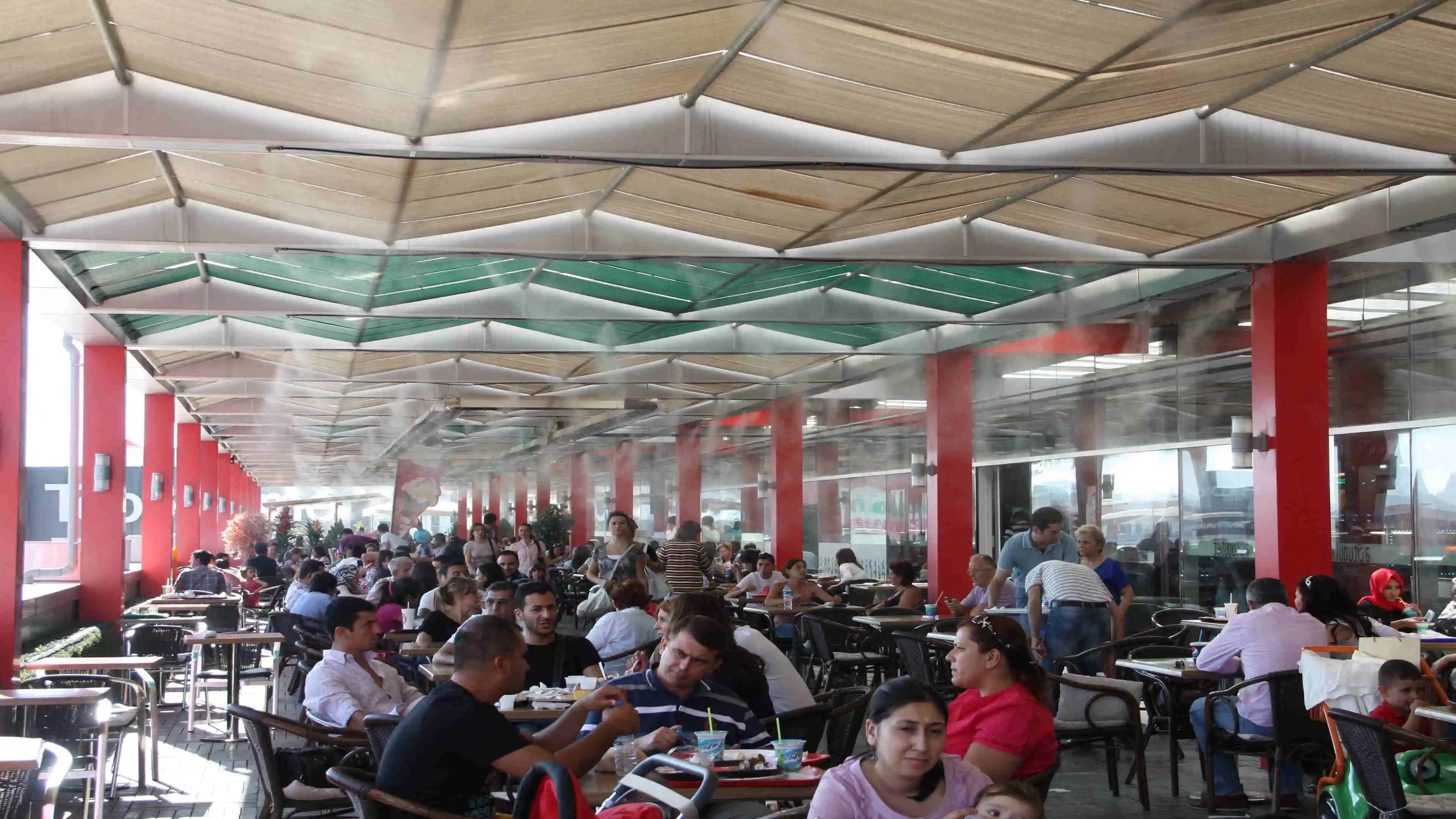
Dip a finger in a glass of water and lift it out: the finger feels cold. As the water evaporates it draws the energy it needs from the nearest source, which is your skin. A misting system does exactly this. The only difference is that it does it with millions of microscopic droplets suspended in the air rather than with a glass of water.
Here is the detail that matters: you are not supplying the energy that does the cooling. The heat already present in the space is what gets spent evaporating the water. Electricity is used only to pressurise and atomise the water. That is where the efficiency of the system comes from.
The physical limit
Evaporation does not continue indefinitely. At a given temperature, air can hold only so much water vapour; once it is saturated, evaporation stops. So there is a floor below which a misting system cannot take the temperature, and that floor moves with the condition of the air at that moment.
In practice no system reaches that theoretical limit. Treat any quotation that gives you a precise figure with caution: the same system gives a different result on a different day, in a different city. We prefer to discuss the climate of your site during the survey and tell you plainly what to expect there.
Why humidity decides everything
The drier the air, the faster water evaporates, and the more heat it takes with it. As the air approaches saturation, evaporation slows and the system runs into its own limit.
This has one consequence that works very much in your favour: the hottest hours of the day are usually the least humid ones. The system performs at its best precisely when you need it most. Early in the morning, or on a humid night, its effect drops off noticeably.
Droplet size
Split a sphere in two and the volume halves, but the total surface area goes up. Because evaporation happens at the surface, dividing the same quantity of water into smaller droplets multiplies the rate at which it evaporates.
What that means in practice: a fog that is fine enough disappears after leaving the nozzle without ever reaching the ground, and the table underneath stays dry. A coarse fog loses to gravity, lands on the surface and wets it. The main thing that determines droplet size is pressure, which is why we install high pressure systems.
Nothing works without air movement
As the system runs, the air around it becomes humid. If that humid air is not carried away, evaporation slows and the system falls victim to its own success. A light breeze does the job by itself; in sheltered corners a fan is needed.
For the same reason, positioning the line relative to the prevailing wind is critical. A line with the wind behind it carries the fog into the seating area; a line facing into the wind has the fog dispersed before it even forms. That is why we ask about wind direction during the survey.
What to expect in which climate
Dry inland climates are close to ideal for evaporative cooling: on summer afternoons the temperature is high and the humidity low. In those regions the difference a well-built system makes is felt within the first minute.
On humid coasts, positioning misting as a standalone cooling solution would be a mistake. There it is used mainly for dust suppression, product humidification, and lowering perceived temperature in combination with fans. Setting the expectation correctly at the start removes the disappointment that otherwise shows up later.
Frequently asked questions
Does misting cool a space the way air conditioning does?
Is misting useless when humidity is already high?
Does the system make the area very humid?
Does the system run continuously?
Related reading
Let's find the right system for your site
Just send us the width, length and height of the area in metres (e.g. 10 m × 20 m, 3 m high). Site survey and system design are free of charge.