
Cooling hotels and resorts
In a hotel, misting is never about one area but several that need to run independently of each other. The success of an installation usually comes from correct zoning rather than from the equipment.
- Typical zones
- 3–6
- Secondary use
- Fog pools, visual effect
- Critical issue
- Water safety and hygiene
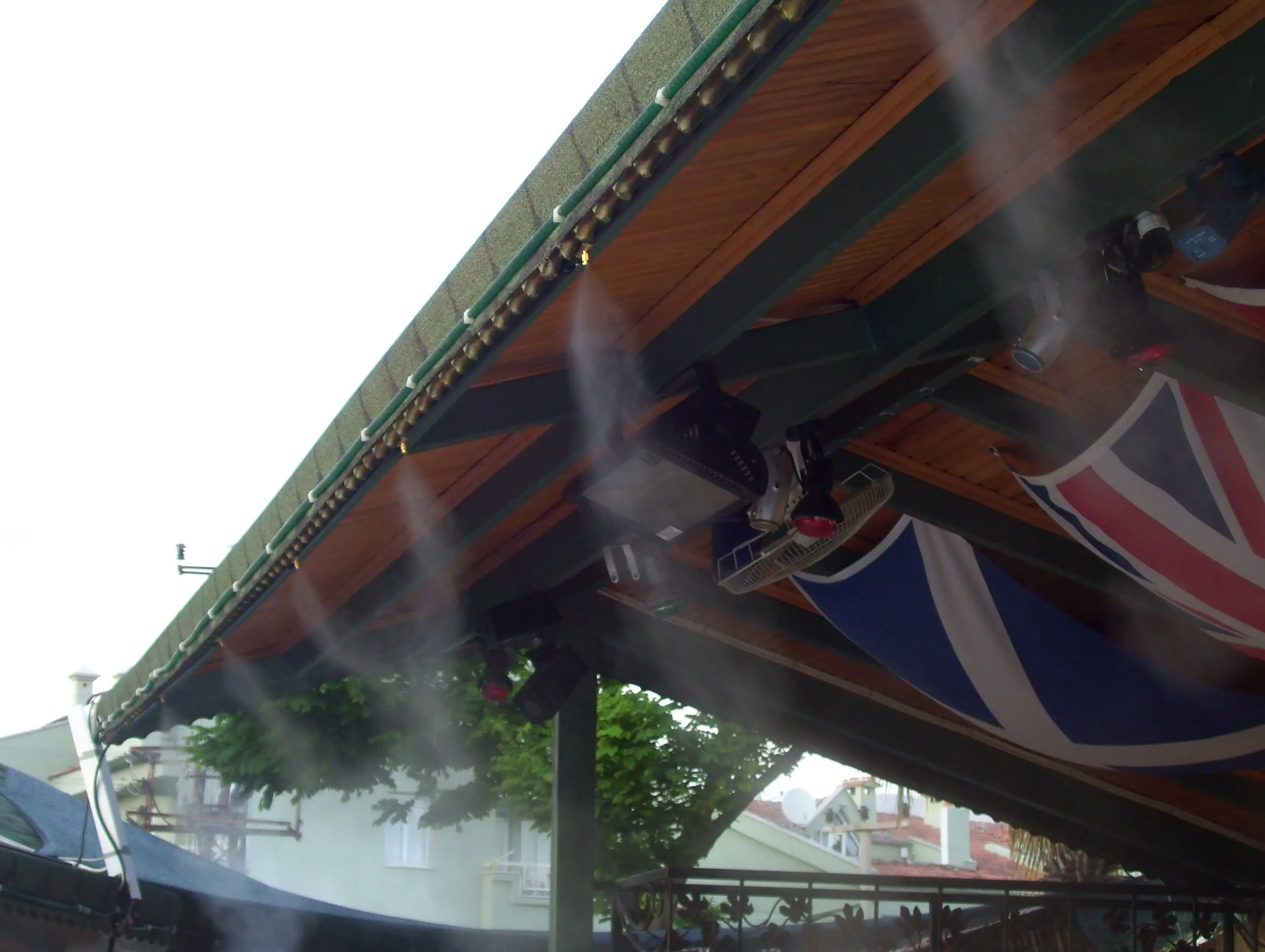
Which areas in a hotel
The areas where misting earns its place in a property have very different needs, which is why they cannot be built to one recipe.
- Open-air restaurant and breakfast area: the priority is not wetting anything. Where food is served, high pressure is the only option.
- Poolside and sunbed area: local humidity is already high. The system runs at a low duty cycle and is positioned so it does not fall directly over the sunbeds.
- Lobby entrance and arrivals: short but heavy footfall. Nozzles are concentrated along the entrance axis so the effect registers quickly.
- Amphitheatre, animation and event areas: used only in the evening; planning them as a separate zone cuts running costs.
- Walkways and garden paths: low priority areas that do not need to run continuously.
Why zoning is essential
Feeding all of those areas from one line creates three problems. First, pressure: on a long line the far points stay weak. Second, operation: the breakfast area needs to run in the morning and the amphitheatre in the evening, and a single line cannot separate them. Third, failure: when one pump stops, the whole property is affected.
The right structure is to divide areas into zones by their hours of use and priority, and control each zone with its own valve. This noticeably reduces water consumption and makes maintenance easier: one zone can be serviced while the rest keep running.
Fog pools and decorative use
A fog pool is a sheet of fog formed by nozzles placed close to the ground and spreading across the surface. The aim is visual rather than thermal; it is used around pool edges, in landscaping and in areas guests photograph.
Three details decide the design. Fog is heavy, so the area needs to be slightly sunken or bounded. Night lighting has to be positioned to light the fog from the side. And the surface material must not become slippery. Without all three, the fog disperses and the effect never materialises.
Hygiene and water safety
In a water system operating in guest areas, hygiene is not a preference but a requirement. The rules are clear:
- Avoid a storage tank if you can. A line fed directly from mains and kept in continuous flow carries very little risk.
- If a tank is unavoidable, keep it closed and opaque. Warm, stagnant and sunlit water is the riskiest combination there is.
- Disinfect the line at the start of the season. A line that has stood empty all winter must be cleaned before the first run.
- Flush after any long shutdown. Before opening a zone that has not run for a few days to guests, run it for a few minutes to clear the standing water out of the line.
The seasonal operating plan
What determines the life of a system on a property is whether season opening and closing are tied to a written procedure. At opening: filter change, line flush, nozzle check and bringing zones online one at a time. At closing: draining the line and removing the nozzles.
Step-by-step lists are on the maintenance and winterising page; on most properties, handing that list to your technical team is enough.
Frequently asked questions
Can misting be installed around a pool?
Is a fog pool the same as a cooling system?
Is a single pump enough for a large property?
Related reading
Let's find the right system for your site
Just send us the width, length and height of the area in metres (e.g. 10 m × 20 m, 3 m high). Site survey and system design are free of charge.