
Cooling livestock housing
Heat stress is paid for in milk, eggs and growth. Misting is the cheapest way to take that load off an animal, provided the line goes over the right part of the building.
- Goal
- Breaking heat stress
- Line goes over
- Feed and loafing area
- Usually needs
- Circulation fans
What heat stress means
Animals have to hold their body temperature steady. As the ambient temperature rises they spend energy maintaining that balance: breathing quickens, feed intake falls, movement decreases. The energy spent is taken out of growth, milk and eggs.
The critical point: heat stress is not set by temperature alone but by the combined load of temperature and humidity. As humidity rises, the animal struggles to shed heat through respiration, and the same temperature weighs far more heavily on a humid day. That is why in humid regions a misting system is never installed on its own, but always with strong air circulation.
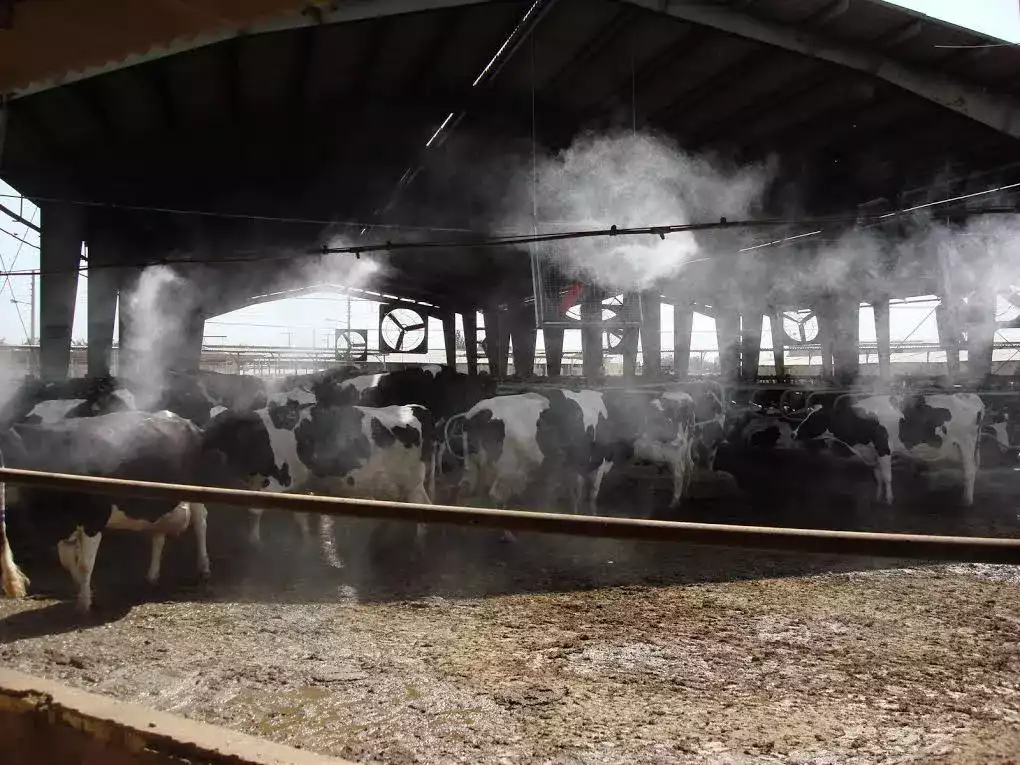
Dairy and cattle barns
Dairy is where the effect of heat stress is most clearly measurable. Through the summer you see a drop in daily milk yield, reduced feed intake and falling conception rates together.
Line placement is critical: misting goes over the feed alley and loafing area, not over the bedding where animals lie. That way an animal that wants to cool down moves to that area and the resting area stays dry. In most barns the system works alongside circulation fans set along the feed line: the fans drive the air and the nozzles release fog into that flow.
Poultry houses
Birds have no sweat glands; they shed heat only through respiration, which makes them particularly vulnerable to heat stress. In poultry houses, misting is usually installed as part of the existing ventilation system at the air inlet, so the warm air drawn in is cooled as it passes the nozzles.
Two things decide whether this works. First, the litter must not get wet; wet litter produces ammonia and foot health problems. Second, humidity has to stay under control; in an enclosed house, once humidity climbs, the system does more harm than good. Both require a high pressure system and sensor-driven control.
Stables and paddocks
In horses, heat stress is both a health and a performance matter, and it particularly lengthens recovery time after work. In stables, misting typically goes over paddock shade structures, wash bays and post-exercise cooling areas.
Inside the stable building, the thing to watch is that aisles and flooring do not become slippery. The line is therefore mounted high and down the centre of the aisle rather than in front of the stall doors. In a wash bay the constraint is lighter, since the floor is wet anyway.
Rules that apply to all of them
- Keep it separate from drinking water lines. The misting line is fed separately and protected with a one-way valve.
- Put the sensor at animal height. A sensor hung from the ceiling does not measure the real temperature in the layer the animals occupy.
- Plan it together with fans. In enclosed and semi-enclosed housing, misting on its own is not enough.
- Do not aim at the bedding. The only thing the system should be wetting is air.
- Dust settles too. In poultry houses and barns, misting also suppresses airborne dust and feather particles, which is a further benefit to respiratory health.
Frequently asked questions
Does misting disturb the animals?
Will the bedding get wet?
Do fans have to be used alongside it?
Related reading
Let's find the right system for your site
Just send us the width, length and height of the area in metres (e.g. 10 m × 20 m, 3 m high). Site survey and system design are free of charge.