
Greenhouse humidification
In a greenhouse the aim is not to cool the space but to hold the humidity band in which the plant can keep transpiring. Every installation that misses this distinction either underperforms or breeds disease.
- Goal
- Relative humidity control
- Band
- Set by the crop
- Required
- Sensor-driven automation
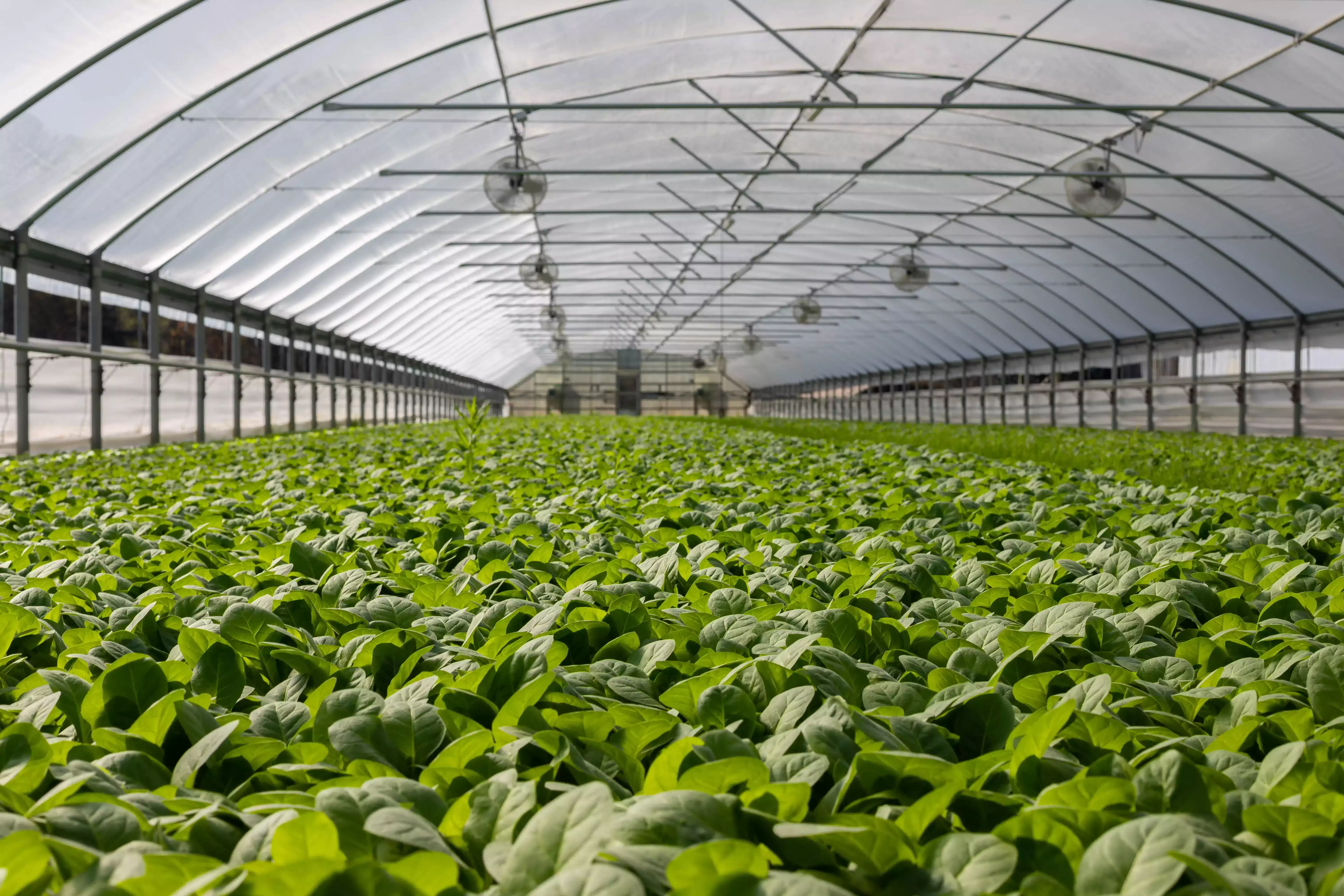
The goal is humidity, not cooling
The most common conceptual mistake in greenhouse projects is to think of the system as a cooler. What matters to the plant is not temperature on its own but how much water vapour the surrounding air can still absorb. The drier the air, the faster it pulls water out of the plant; the plant responds by closing its stomata, and photosynthesis slows.
A misting system intervenes in that cycle by raising humidity. The temperature drop is a by-product, not the purpose. So the measure of success in a greenhouse is not “how many degrees did it drop” but “how many hours did humidity stay inside the target band”.
What the plant actually experiences
Horticulture uses a measure that combines temperature and humidity rather than treating them separately: how far the air is from saturation. The same relative humidity reading can be comfortable for a plant on a cool day and mean serious stress on a hot one, because warm air can carry far more water.
The practical consequence: a system wired only to a humidity sensor will make wrong decisions. A control unit reading temperature and humidity together runs more often during the hot hours and less often when it is cool, which saves water and actually protects the crop.
Installing in a greenhouse
- Line height: clearly above the crop canopy. The point is for the droplet to evaporate before it reaches a leaf.
- Nozzle spacing: a greenhouse has volume, so nozzles can be spaced more widely than in a comfort installation.
- Line arrangement: parallel runs along the length of the house. In wide houses the spacing between runs is set by the width.
- Coordination with ventilation: running the system while the roof vents are open wastes water. Both should be managed from the same panel.
- Zoning: where there are different crops or different growth stages, the house is divided into sections, each working to its own target band.
What is different in mushroom growing
Mushroom production has a far tighter tolerance. Humidity is held within a narrow band, and leaving that band affects yield directly. Temperature likewise has to stay stable within a narrow range.
For that reason the system in a growing room does not run continuously but in short bursts triggered by sensor deviation. The other difference is air circulation: fresh air is supplied constantly so carbon dioxide does not build up, and that air has a drying effect. The misting system's job there is to give back what the ventilation takes away.
Nozzle choice differs too: because it is critical that droplets do not land on the bags or compost surface, the finest orifice sizes are used. The full picture is on the mushroom farms page.
It does not work without automation
In comfort installations a simple timer is usually enough. In a greenhouse it is not. While the outside air changes continuously, a system running on fixed intervals delivers too little humidity during one part of the day and too much during another.
The minimum build is this: a temperature and humidity sensor, a control unit with the target band defined, and an interlock that stops the system working against the ventilation. Add data logging on top of that and you can look back at the end of the season, see which hours fell outside the band, and improve the settings.
Frequently asked questions
Does a greenhouse misting system replace irrigation?
Does misting create a disease risk on leaves?
Is automation necessary even in a small greenhouse?
Related reading
Let's find the right system for your site
Just send us the width, length and height of the area in metres (e.g. 10 m × 20 m, 3 m high). Site survey and system design are free of charge.