
What are misting systems, and is fogging the same thing?
Half a dozen words describe the same technology, and none of them tell you what you actually need to know. Here is what the terms mean and which question to ask instead.
- Mechanism
- Evaporative cooling
- What differs
- Pressure, not terminology
- Ask about
- Operating pressure
What misting means
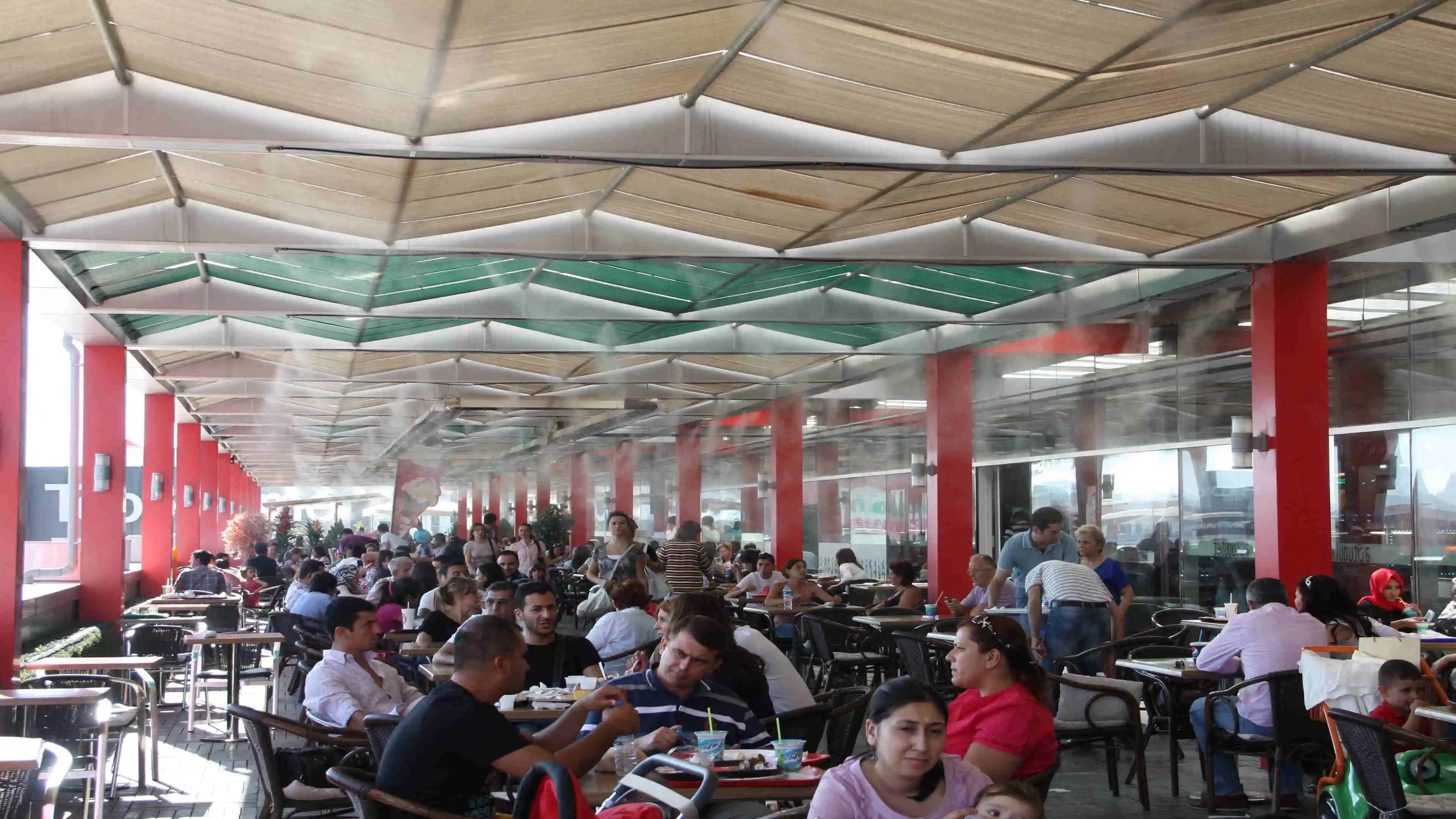
Misting comes from “mist”, and misting systems are systems that break water into very fine droplets under pressure and release them into the air. Those droplets evaporate, and evaporating draws heat out of the air. That is the entire mechanism, and every product in this category rests on it.
It is worth saying plainly at the outset that the mechanism has a limit. Air can only hold so much water vapour, so in humid conditions there is less cooling available no matter whose system you buy. Anyone quoting you a fixed temperature drop without asking where your site is has skipped the most important variable.
The same job under different names
You will come across all of these, and they overlap heavily:
- Misting: the most common term for the technology, and the one usually used for fixed-pipework installations.
- Fogging: used interchangeably with misting. Where a distinction is drawn, it implies a finer droplet, but no standard enforces this.
- Atomising: describes breaking a liquid into very fine particles. Preferred in applications other than cooling, such as dust suppression and spraying.
- Humidification: used when the aim is to raise humidity rather than lower temperature, as in greenhouses and industrial processes.
- Evaporative cooling: the name of the physical principle, not of a product category. Pad-and-fan coolers also work this way.
- Misting fans: a fan with atomising nozzles attached, usually portable.
None of these words is wrong, and none of them tells you what the system will actually do in your space. Which brings us to the question that does.
The difference that actually matters
Ask what pressure the system runs at. That one answer tells you more than any product name.
Low pressure systems run off mains water pressure. They are cheap and simple, and they produce a visibly coarser droplet. That droplet does not fully evaporate in the air, so it lands: furniture, floors and people get damp. For a garden path or a livestock yard this may be perfectly acceptable. For a restaurant terrace it is not.
High pressure systems use a dedicated pump to break the water far more finely. The fog is gone before it reaches a surface, which is what makes the difference between cooling guests and soaking them. It costs more, needs filtration, and is the only approach we install.
Nearly every complaint of the form “we tried misting and it made everything wet” traces back to a low pressure system being used where a high pressure one was needed, or to worn nozzles on a line that was never maintained.
Which one suits you
Whatever term you searched for, the underlying need is usually the same: cooling an open area with water, or holding humidity at a given level. We meet both with a fixed-pipework high pressure misting system engineered for the specific site.
The advantage of a fixed line is that the whole area is treated evenly and no appliance stands in the space. The larger the area, the more pronounced that advantage becomes. Where a portable unit would genuinely serve you better, we will say so; the comparison is on the misting fans page.
To find out what your site needs, send us the width and length through the contact form or call 0507 492 02 04, and we will share an assessment for your area.
Frequently asked questions
Is fogging the same as misting?
Is an atomising system the same thing?
Is a humidification system different?
Is evaporative cooling the same as air conditioning?
Related reading
Let's find the right system for your site
Just send us the width, length and height of the area in metres (e.g. 10 m × 20 m, 3 m high). Site survey and system design are free of charge.